Why TVs Get Cheaper—and Homes and Healthcare Don't
Walk into any store in America and you'll find a better television than last year. Bigger screen, cleaner picture, lower price. Something got better. Something worked.
Then go try to build a house. Or pay a hospital bill.
The contrast isn't incidental. It is telling us something true — and something troubling — about the kind of economy we have built.
Some things get cheaper over time. Some things don't. And it is not an accident which is which.
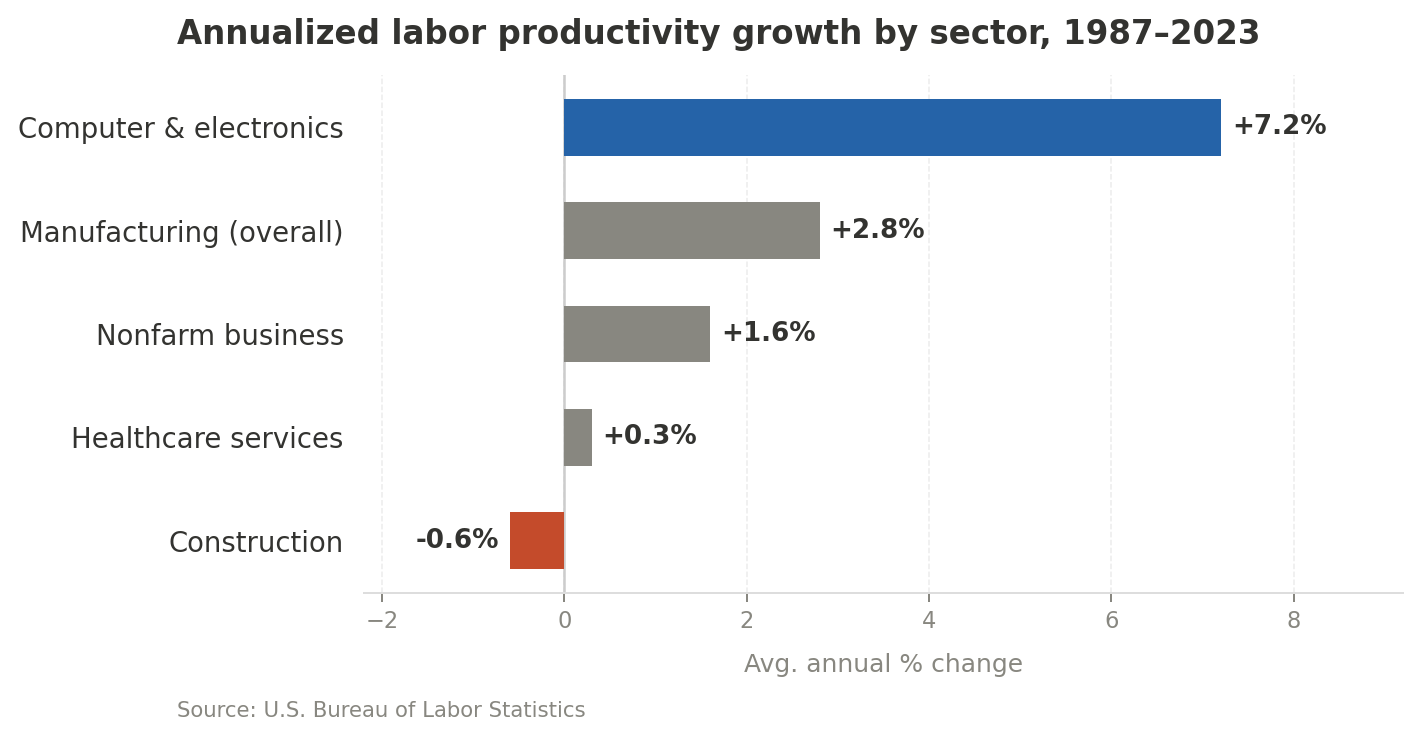
Televisions are products. They are made by the millions, in factories tuned to near-perfection, in a global system built for relentless improvement. Since 1987, labor productivity in the computer and electronics sector has grown at an annualized rate of 7.2 percent per year. Every year the engineers find another way to take cost out and quality up. The price falls. That is the system functioning as it should.
A home is something different.
A home in Salt Lake City — in any American city — is not a product. It is a singular thing, built on a particular piece of earth, governed by rules that are local and layered and slow, assembled by craftsmen who are harder to find every year. You cannot mass-produce a neighborhood. You cannot automate a permit.
And here is what that has meant in practice:
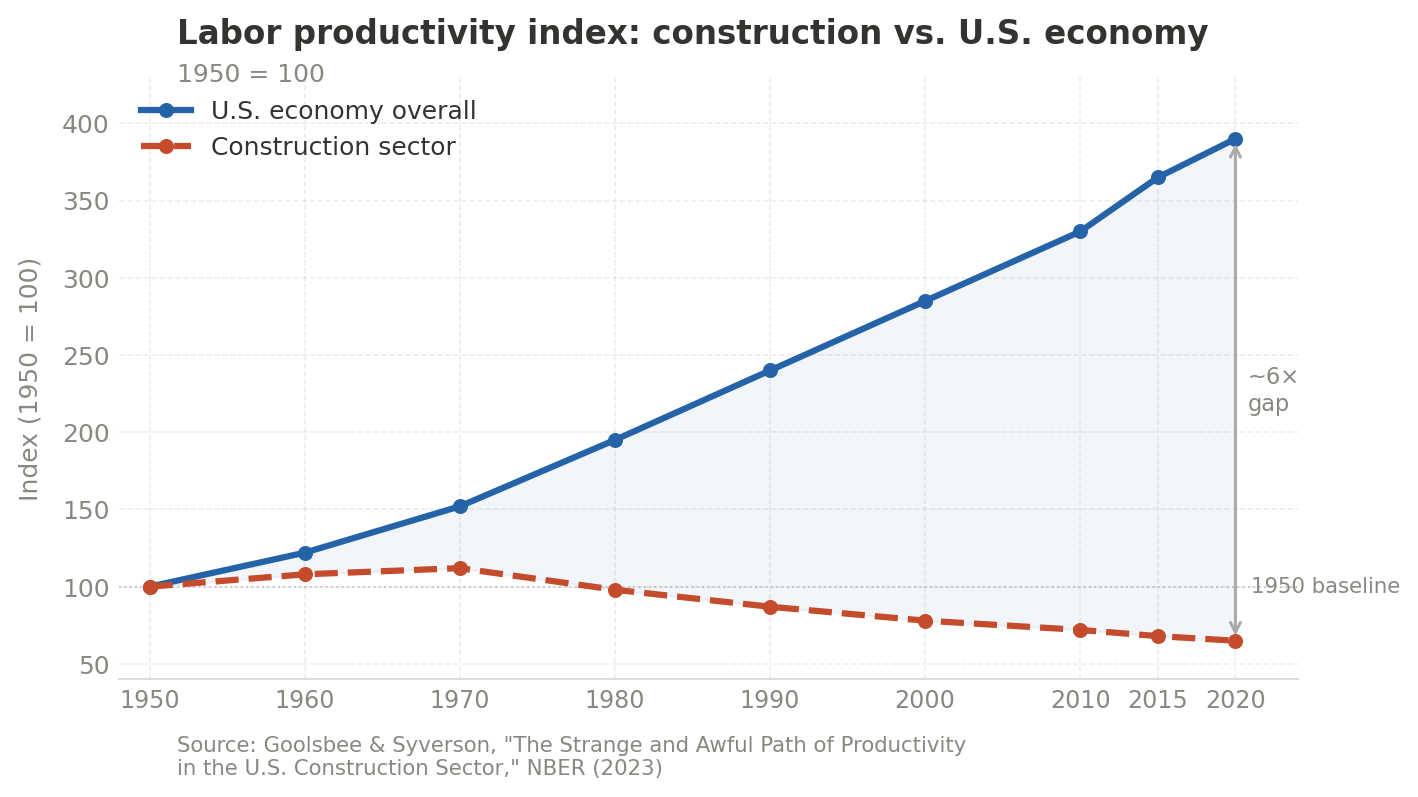
Since 1970, construction labor productivity has fallen at an average rate of roughly one percent per year. Not stagnated. Fallen. By 2020, the value added per construction worker had dropped to below what it was in 1950 — while the rest of the economy became nearly four times more productive over that same period. A construction worker today, on average, builds less than his grandfather did. We have more technology, more capital, more everything — and we are getting less.
The researchers who documented this called it, with admirable plainness, "stunningly bad productivity performance for a major sector."
They were right.
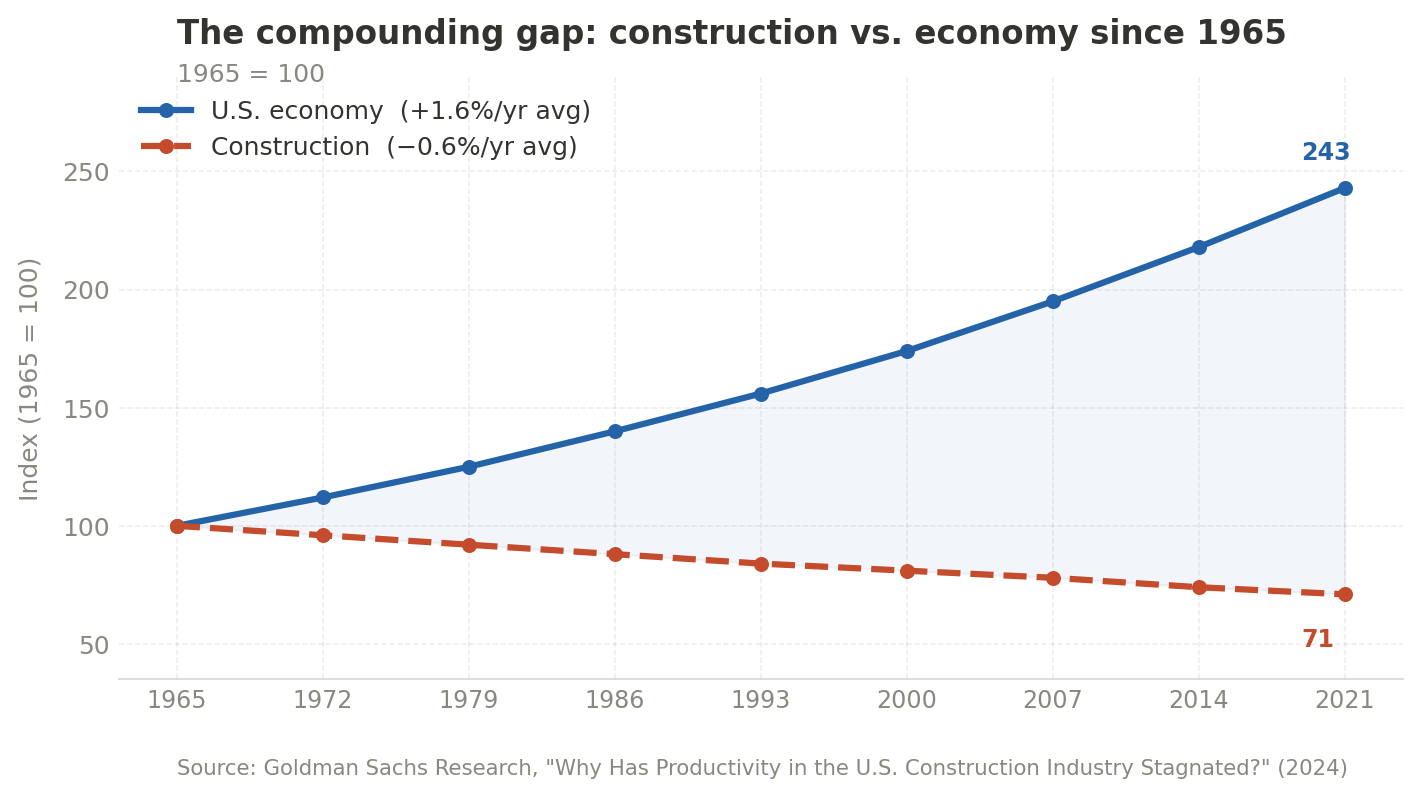
Part of the answer is regulation. Goldman Sachs Research estimates that increased land-use regulation since the 1960s has reduced annual construction productivity growth by roughly 0.7 percentage points — nearly erasing the 0.8 percentage point boost the sector received from technological change over the same period. Regulation gave with one hand and took with the other, and then took a little more.
Part of the answer is scale. Firms with 20 to 99 employees produce 45 percent more units per worker than the smallest firms. Yet zoning rules and permitting friction keep the industry fragmented — thousands of small builders, none large enough to invest seriously in technology or process improvement. Construction patenting stagnated after 1970. Manufacturing patents kept growing. The divergence in innovation followed the divergence in productivity almost exactly.
Healthcare goes even further.
In medicine, demand is effectively limitless. We age; we need more care. New treatments arrive and do not replace old ones — they add to them. The normal discipline of a market softens, because someone else — an insurer, the government — is usually paying, and the patient rarely knows the price before the bill arrives. The workforce at the center of care — doctors, nurses, the irreplaceable human beings on whom lives depend — cannot simply be automated away. And so the costs climb.
Economists call the underlying pattern Baumol's Cost Disease. Sectors that grow more productive see their prices fall. Sectors where productivity grows slowly — construction at negative 0.6 percent annually, healthcare services at roughly 0.3 percent — see their costs rise, because wages increase without a matching rise in what each worker produces. The television on the wall gets better and cheaper every year because the factory making it learned to do more with less. The house around it costs more every year because the industry building it, on average, has learned to do less with more.
That is not a law of nature. It is a function of choices.
We know, in broad terms, what the remedies look like.
In housing, we have confused process with purpose. We regulate the size of a home, the shape of a lot, the height of a wall — and then we wonder why so few can afford one. The question worth asking is simple: what does a decent home actually require? Not what the code says. Not what the review board approves. What does a family actually need? If we started there — from the outcome rather than the process — we might find that the answer is smaller, simpler, and considerably less expensive than what we have spent fifty years building toward.
In healthcare, it means restoring transparency — so that the price of care is knowable before the bill arrives. It means shifting care out of the most expensive settings when lower-cost settings can do the work just as well. It means using technology not only to add new treatments, but to reduce what it costs to deliver the ones we already have. And it means honestly confronting the administrative apparatus that consumes, by some estimates, nearly a third of every healthcare dollar before a single patient is seen.
None of this is simple. Homes and hospitals are not televisions. They are local, human, consequential. They carry risks — financial, physical, moral — that demand we proceed with care.
But the current trajectory is not sustainable, and more than that, it is not fair. We have built an economy where the things we want — the entertainments, the devices, the diversions — grow better and cheaper with each passing year. And the things we need — a roof, a doctor — move in the opposite direction, year after year, decade after decade, with a compounding force that is quietly reshaping who can afford to live a decent life in this country.
That is the result of choices. Policy choices. Political choices. The choices of a society about what it will make easy and what it will make hard.
The television on the wall gets better every year, and costs less. The house around it may be nicer than it was — more square footage, better finishes, smarter systems. But it costs more, far more, than any of those improvements would justify. That gap is not progress. That is a system that has forgotten how to be efficient.