Jazz or Orchestra? Two Ways to Play the Music of Social Impact
Utah has had a jazz team since 1979. The franchise came from New Orleans and kept the name. People still joke about the fit.
They shouldn't. Utah plays more jazz than it gets credit for.
Jazz is the music where no one on the bandstand knows exactly what the next eight bars will sound like, and everyone knows where the song is going. That is a fair description of how this state does hard things. Business leaders, faith communities, nonprofits, and elected officials keep finding their way to the same table. Watch them long enough and you see two ways of making music together. One is an orchestra. The other is a jazz band.
Both are beautiful. They are just different.
The Orchestra
An orchestra is a marvel. Eighty musicians, one score, one conductor. Every note written down. Every entrance rehearsed.
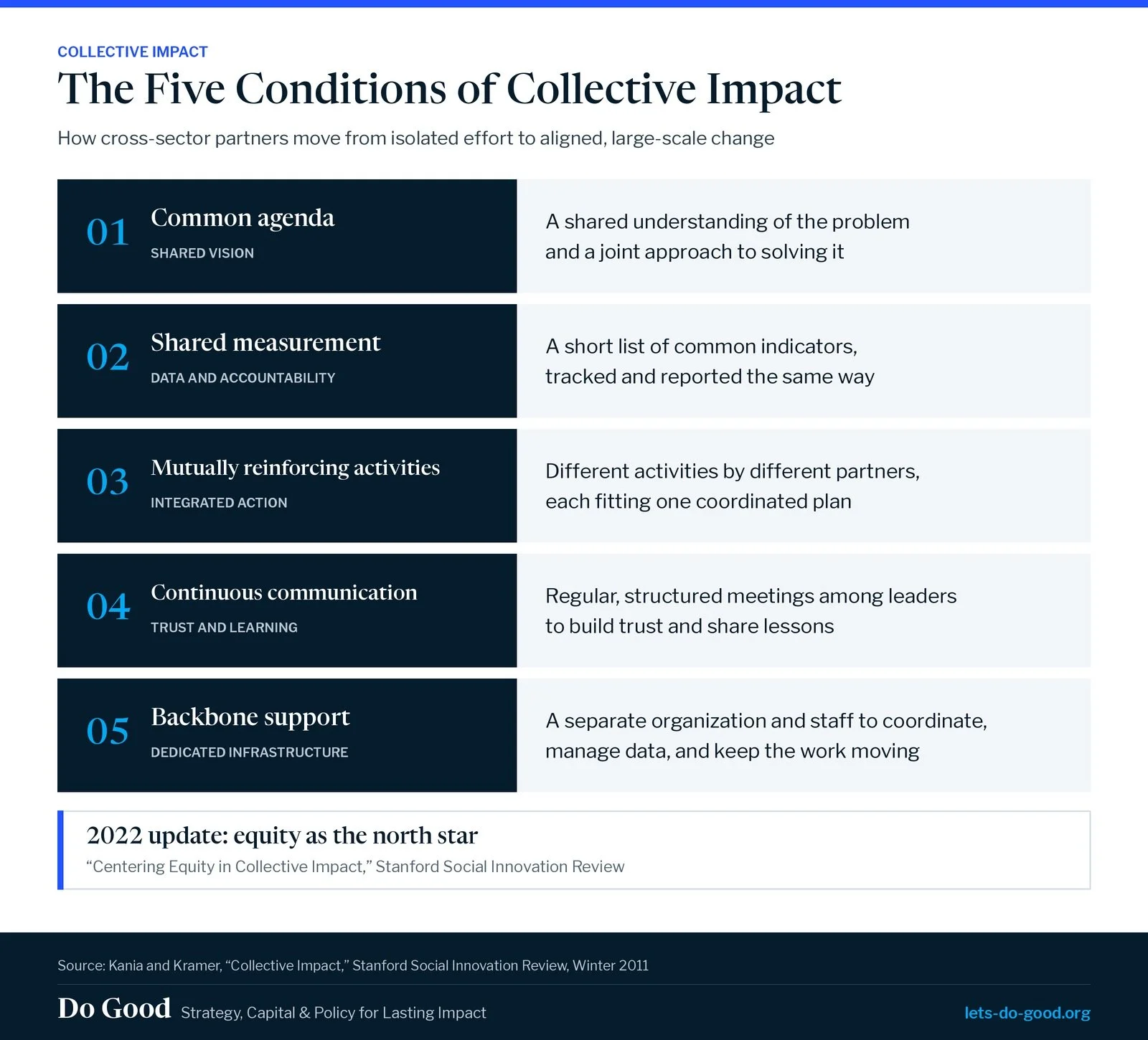
In 2011, John Kania and Mark Kramer handed the social sector its score. Their essay in the Stanford Social Innovation Review, "Collective Impact," argued that big problems are not solved by isolated organizations doing isolated good. They are solved when many actors align around five conditions: a common agenda, shared measurement, mutually reinforcing activities, continuous communication, and a backbone organization to hold it together. The backbone became the conductor. The shared metrics became the score. The field was better for it.
When a problem is well understood, the orchestra is hard to beat. Discipline is not the enemy of impact. Often it is the price of it.
The Utah Housing Preservation Fund is good example of an orchestra. Civic leaders set out to preserve the affordable homes Utah already has, and they wrote every part down. Term sheets and fund docs defined who played what, and when. Blended capital let philanthropic, private, and public dollars each carry the risk they were built to carry. The private sector led. The public sector brought the mission and the commitment: nearly $60 million in state support and the policy change that made the fund Utah's default public-private preservation effort. When the stakes are high and the instruments are expensive, you want everyone reading from the same page.
The Jazz Band
A jazz band works from a different kind of agreement. There is a key, a tempo, a melody everyone knows. Beyond that, the musicians listen, respond, and build something no one could have written in advance.
When Miles Davis recorded Kind of Blue, his players had little more than sketches. Much of the best-selling jazz album of all time was captured in first takes. It was not chaos. It was mastery and trust.
Jazz is also entrepreneurial music. Every solo is a small venture. The player sees an opening, takes a risk, and commits before knowing how it will land. Frank Barrett, a jazz pianist turned management scholar, argues in Yes to the Mess that great bands say yes to what is happening rather than wait for certainty. They trade roles. One moment you solo. The next you comp, laying down support for someone else. Karl Weick made a similar case. Improvisation is not the absence of preparation. It is preparation meeting the moment.
The collective impact field came to the same place. In 2013, Kania and Kramer returned to SSIR with "Embracing Emergence," arguing that in complex systems the best solutions are often not known in advance. They emerge. Shared measurement exists not to lock in a plan but to help partners learn faster and adapt. Liz Weaver and Mark Cabaj, writing on Collective Impact 3.0, pushed for less management and more movement. Kania, Kramer, and Peter Senge pointed toward r
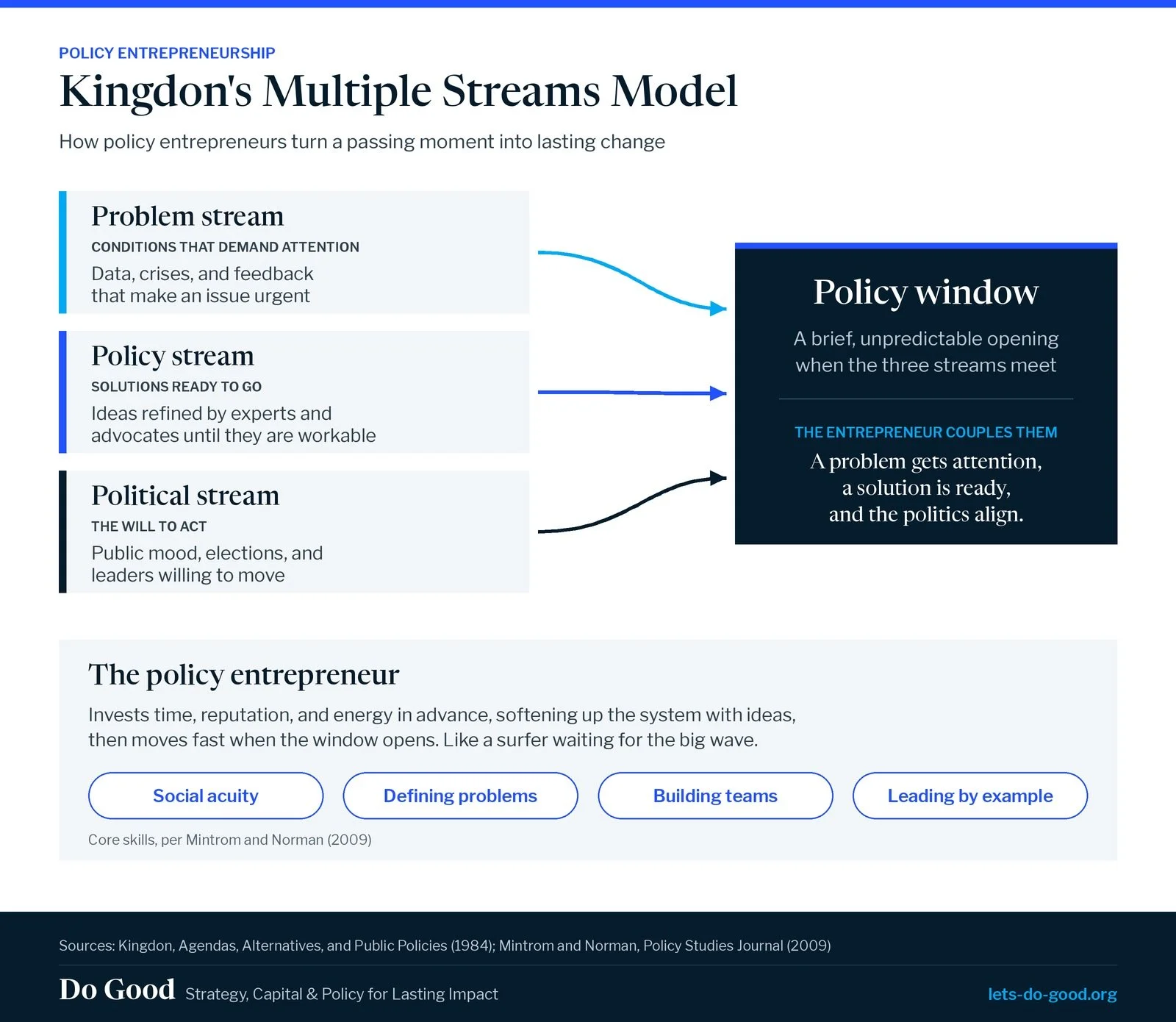
Policy has its own jazz players. John Kingdon called them policy entrepreneurs. In Agendas, Alternatives, and Public Policies, he described people who soften the ground with ideas for years, then move fast when a window opens and a problem, a solution, and the politics finally line up. Kingdon compared them to surfers waiting for the big wave. Call them soloists waiting for their eight bars. Michael Mintrom and Phillipa Norman later named the craft: social acuity, defining problems, building teams, leading by example.
John Elkington and Pamela Hartigan had a name for such people. In The Power of Unreasonable People, they borrowed from George Bernard Shaw: "The reasonable man adapts himself to the world; the unreasonable one persists in trying to adapt the world to himself. Therefore all progress depends on the unreasonable man." Jazz has always belonged to the unreasonable. So does good policy entrepreneurship.
“The reasonable man adapts himself to the world; the unreasonable one persists in trying to adapt the world to himself. Therefore all progress depends on the unreasonable man.”
The Utah Housing Preservation Fund did not begin as an orchestra. Before there were term sheets, there was an idea, a group of civic leaders willing to back it, and a legislative window that would not stay open forever. The jazz came first. The orchestra came after. Often the entrepreneur's job is to improvise long enough to earn the right to write the score.
Social Impact Work is Not a Performance
The orchestra is not rigid, and the jazz band is not undisciplined. They play the same instruments: capital, policy, data, partnerships, people. And neither works without talent. Utah's real advantage has never been a framework. It has been a deep bench of people who know how to play, and play together well.
Some problems are complicated but predictable. A bridge. A proven reading curriculum. A housing fund with a clear legal structure. Play the orchestra. Others are complex and change as you touch them. A neighborhood in decline. A family's path out of crisis. Play jazz.
Often the same project needs both. Take the capital stack on an affordable housing deal. Much of it is orchestra. Low-Income Housing Tax Credits come with their own score. Lenders set debt coverage ratios. Area median income limits cap the rents. Every part is written down. But the gap, the last dollars between what the project costs and what the structured sources will cover, is almost always a jazz band. A foundation here, a city loan there, a bank's community reinvestment dollars, a donor willing to take the risk no one else will. No one writes that part in advance. It gets played.
I like both. Most real work needs both. What matters is that the outcome stays the goal, not the sheet music. Plans matter. But too many coalitions fall in love with the score. The logic model becomes the goal. The meeting schedule becomes the goal. And somewhere along the way, the family the work set out to serve becomes an afterthought.
The audience does not come for the sheet music. They come for the music.
Utah knows the melody. Salt Lake City ranks among the strongest places in the country for upward mobility, and Utahns volunteer at some of the highest rates in the nation. Neighbors showing up for neighbors is the tune this state knows by heart.
Cities Strong Foundation tries to play that tune across seven cities along the Wasatch Front, agreeing hard on the outcome and staying loose on the path. In the orchestra sense, it plays second chair to myHometown, whose efforts, volunteers, and facilities are the base the work stands on. Cities Strong Foundation then amplifies them with capital, data, and coordination. That is comping, and it is not a lesser role. The rhythm section is what makes the soloist sound good.
Social impact work is not a performance. It is a promise: to a child who needs to read, a family that needs a home, a neighborhood that needs a future. The score is a tool. So is the solo. Neither is the point.
So write the score when you can. Improvise when you must. Fund the musicians, not just the music stand. Measure what changes in people's lives, not how faithfully the plan was followed. And keep listening to each other, across sectors and across seats, until the outcome is real.
That is when the music gets good. That is when a place becomes a home.
Is your work an orchestra or a jazz band right now? And are you playing for the score, or for the people in the room?